
Napa's Rolling-Week Arrest Log
The official home of this multi-day view is the Napa County CJNet Booking Report. CJNet describes the report as covering the past week. Rows reach back roughly seven days. Trust the live table and its timestamp over any fixed assumption about depth.
Napa County does not call this a police blotter. Nothing beside it serves as a permanent public archive. Every row represents a jail booking processed by the Napa County Department of Corrections, and the report pulls from the whole county. An arrest may originate with Napa Police, Sheriff services in American Canyon, St. Helena Police, another agency, or a court remand. Local departments handle news differently. The booking log itself stays county-wide regardless.
The official booking-report page is the starting point for the current published week.
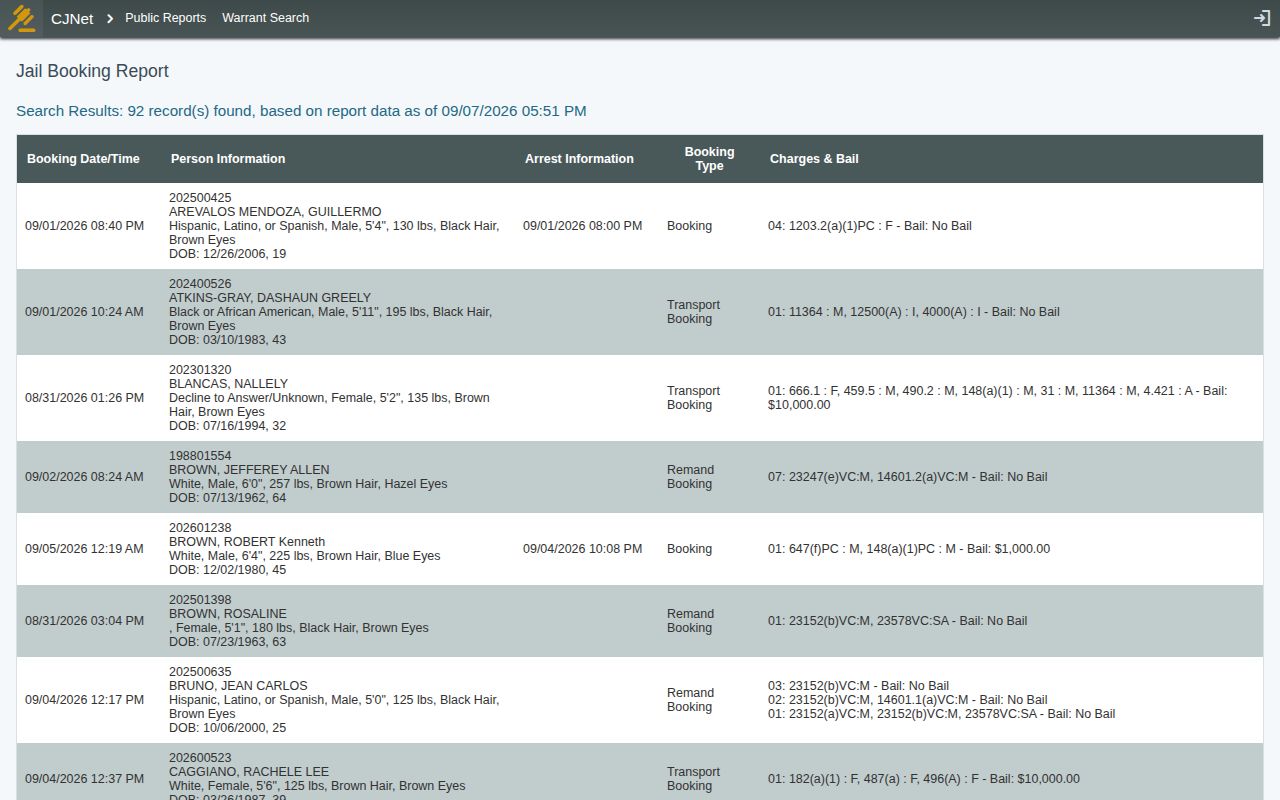
What you see is a text table. It lists booking activity for the week. There is no photo gallery here. Nor is it a complete history of every arrest in Napa County, since it only reaches as far back as the rolling window allows.
Reading the Napa County Blotter
Start with the booking date. Work backward through the report from there. Before drawing any conclusion, confirm the person's identity and the booking type listed for that row. For the narrower same-day question, the newest-row workflow on the 24 Hour Arrests page is the better fit.
- Open the Booking Report and record its “based on report data as of” timestamp.
- Review the entire past-week date range, not only the top rows, and identify today's oldest visible booking date.
- Match a name with a booking identifier, DOB or age, physical description, booking date, or another specific field. A shared name is insufficient.
- Compare Booking Date/Time with Arrest Information. Booking can follow arrest, while a transport or remand may have no displayed arrest time.
- Read Booking Type before treating a row as a new street arrest. Transport and remand describe different paths into the jail record.
- Use the In Custody Report for current detention and Release Report for past-week releases.
- Request an official record when an entry has rolled beyond the week.
The report can shift while you view it. Charges, bail, release details, and custody status are separate developments. They do not always update together. When accuracy counts, save the date you retrieved the entry along with its source. The originating agency or the court can speak to whatever stage came later.
Fields in an Arrest-Log Entry
CJNet sorts booking data into broad columns. Not every field appears in every row. The report implements only part of the public arrest-information field set. Expect a summary rather than an exhaustive intake sheet for each arrested person.
| Field | Meaning and caution |
|---|---|
| Booking Date/Time | The jail-intake time that places an entry within the rolling week. |
| Person Information | Can contain name, booking number, race or ethnicity, sex, height, weight, hair, eyes, DOB, and age. Confirm identity with several points. |
| Arrest Information | May supply arrest details, but can be blank on transport or remand entries. |
| Booking Type | Separates booking, transport booking, and remand booking, preventing an inaccurate new-arrest count. |
| Charges & Bail | Reports booking-level statutes, severity markers, and bail. These are charges and preliminary conditions. |
| Photo | The observed public interface displayed no photo column, thumbnail, or image link. |
A booking photo can exist even when none appears online. Napa Corrections decides release case by case. While someone remains in custody, the Director or Administrative Lieutenant must approve any photo release. The table here is not a mugshot log, and no booking faces are hosted or republished on these pages.
Weekend Arrests and Delayed Rows
Napa County publishes no special weekend or holiday refresh schedule. Claims that CJNet stops, updates overnight, or delivers a guaranteed morning batch would be inaccurate. What is certain is simpler. The report refreshes and prints a current data timestamp. Intake, data entry, and publication can each take their own time. An arrest and its visible row can land at different points. Reading a Monday or post-holiday log? Use dates and times rather than row counts alone. A cluster of entries may reflect processing timing, transports, or remands. It may not signal a surge in policing. For named-person custody and release cross-checks, the county-wide recent-arrests hub lays out the steps. The official Release Report can also help. It explains why someone in the week's booking log no longer shows in current custody.
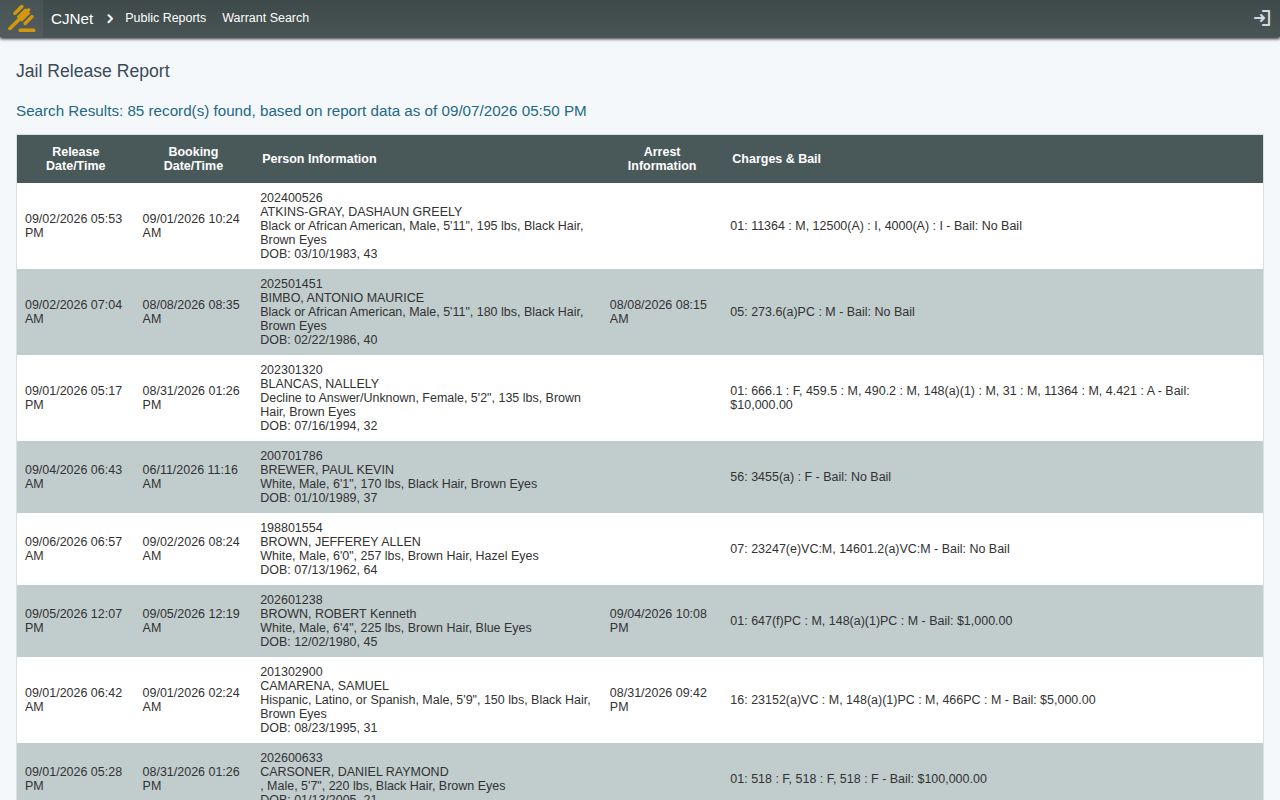
A release answers a later custody question. It does not erase the booking. The arrest stays on the log. Nor does it settle the case outcome.
Arrest-Log Archives and Rolloff
When a row rolls off, the record still exists. Online rolloff is not record destruction. CJNet offers only past-week Booking and Release reports. It also has a current-state In Custody Report that may show older booking dates for people still held. No permanent booking-feed archive is linked from CJNet. For an older booking, start with the Records & Documents page. The Public Records Search & Request route is the other path. Give the full name, DOB if known, and booking number. Add the approximate date, arresting agency, and exact record type. Ask that both active and County Records Center holdings be searched. Request that the custodian state whether an item was destroyed under schedule, transferred, withheld, or not located. History has a paper trail here. A 2014 Board item confirms approved Sheriff retention schedules. It also confirms the transfer of department-identified historical records to the Records Center's archival section. It offers no booking-photo-specific retention period. So no fixed number of years can honestly be promised. Beware of similarly named repositories. The county Recorder-Clerk official-records portal is not the booking archive. The California State Archives holds historical state records, not a current Napa booking-photo index. Begin with the current county custodian. Ask about Records Center holdings. Only then try a library for contemporaneous news coverage.
Local Police Logs Versus Jail Arrests
Napa County's cities publish very different narrative sources. The official Napa Police press-release archive carries selected arrest announcements, DUI checkpoint results, saturation-patrol outcomes, and safety campaigns. It runs on events, not on a full daily booking list. American Canyon posts city news on no fixed schedule, and St. Helena activity has long surfaced in a weekly Star/Register police-log tradition covering calls, citations, arrests, and warnings. For a clear look at that selected-event format, browse the official Napa Police archive.
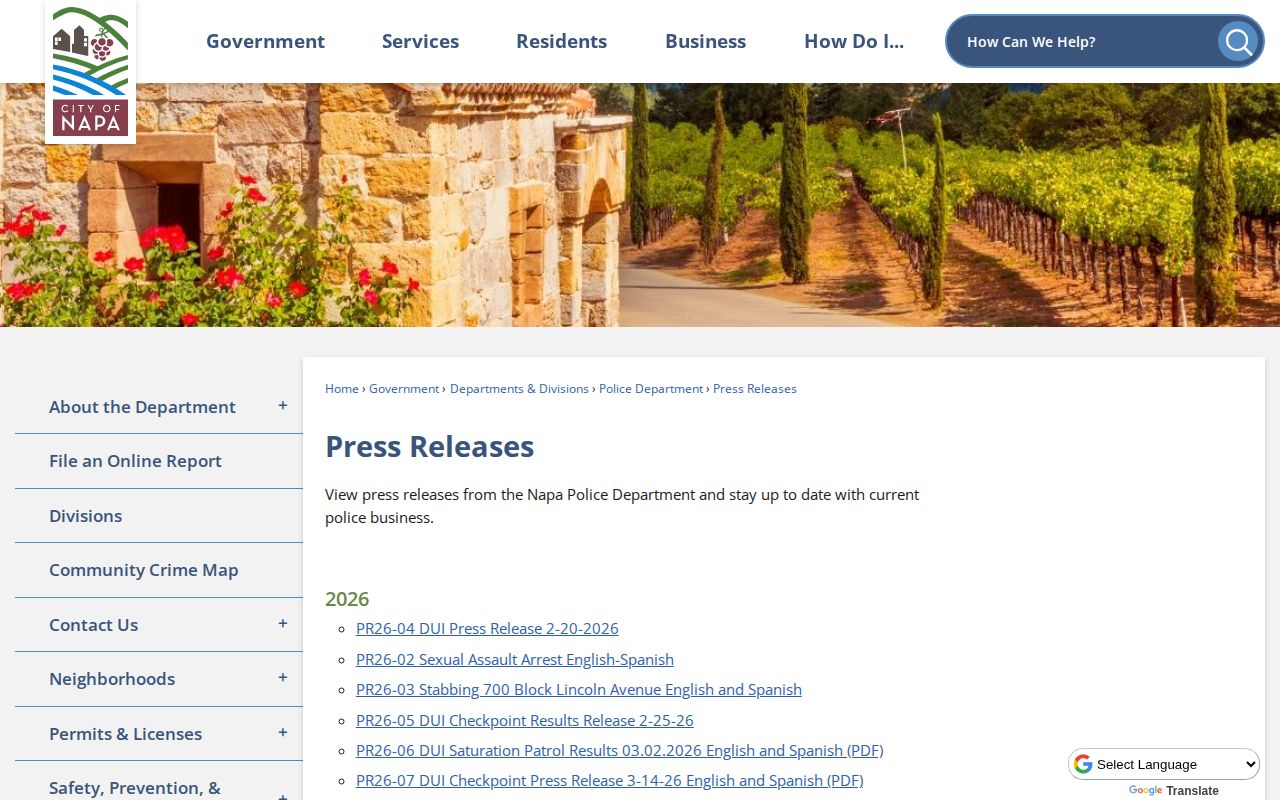
A press release tells one story. It never covers every booking. The Napa Valley Register and the St. Helena Star can add depth, including older police-log coverage, though they remain secondary sources. Commercial arrest sites are weaker. They copy, delay, or garble booking data, and names sometimes get mismatched.
No aggregator replaces CJNet, the Records Bureau, or the court. For old news, two libraries help. The St. Helena Public Library Napa County newspaper archive and the Napa Public Library newspaper resources cover local titles. Search by publication, date range, city, and subject. For the booking itself, use the County Records Bureau; for the later case, Napa Superior Court.
Each source answers a different question. An arrest announcement may carry an agency narrative that CJNet lacks, while CJNet can hold a processed booking that never earned a press release. A newspaper police log can summarize calls and citations that produced no jail booking at all. That is expected, not a contradiction, so note the publisher, coverage dates, and custody state before comparing entries.
Booking Charges Are Accusations
A booking row is a snapshot. It reflects intake information, nothing more. The row never grows into a complete case history. What happened after the arrest, from charge changes to the final outcome, lives with Napa Superior Court. Check there.